

The best protractors for woodworking combine exact angles, rugged builds, and readable scales.
You can get a joint perfect on the first cut when your angles are right. But I know how it feels when a miter looks tight on the bench and opens up on the wall. Small errors in layout add up.
The right protractor saves time, wood, and frustration. It lets you mark and set angles fast, check your saw tilt, and repeat cuts without guesswork. In this guide, I share the best protractors for woodworking I trust for layout, machine setup, and on-site installs.
5 Best Protractors for Woodworking
General Tools #17 Stainless Steel Protractor

This classic stainless steel protractor earns its spot in many shops. The square head gives you a solid reference against a board edge or machine fence. The locking knob lets you fix any angle and carry it from your bench to the saw. Markings are etched into the steel, so they resist wear and stay readable.
It is slim, pocketable, and built to last. I like it for quick layout of miters, bevels, and small parts. The long blade reaches across face frames and narrow stock. If you want one tool to handle layout and transfer, this is a dependable, low-tech choice among the best protractors for woodworking.
Pros:
- Square head references edges for repeatable layout
- Etched stainless graduations that don’t rub off
- Locking knob holds angles during transfer
- Thin blade slips under clamps and into tight spots
- Durable steel body resists shop abuse and rust
- Two-way scale helps with inside and outside angles
Cons:
- No digital readout for fine machine calibration
- Blade length may feel short for large panels
- Requires good lighting to read fine graduations
My Recommendation
If you do trim, furniture, or detailed joinery, this is a strong everyday pick. It shines when you need to mark, carry, and confirm angles on the fly. The square head and locking blade make it fast. For many woodworkers, this tool alone handles most layout jobs. It is one of the best protractors for woodworking if you want a reliable, analog standard.
| Best for | Why |
| Transferring angles to saws | Locking blade holds your exact reading from workpiece |
| Daily bench layout | Square head references stock edges for quick marks |
| Durability on site | Stainless steel with etched marks stands up to wear |
4-Inch Clear Plastic Protractors (2-Pack)

This small, clear plastic pair is budget-friendly and handy. I keep one near my sketch pad and another at the bench. The transparent body lets you see the grain, pencil lines, and edge of your board. For marking quick angles on templates, jigs, or small parts, they do the job.
They are not heavy-duty. But when you need a fast 30°, 45°, or 60°, you can grab one without worry. Their thin profile slides into a tool roll or apron pocket. If you want a low-cost helper to back up your main gauge, this set can round out your kit of the best protractors for woodworking on a budget.
Pros:
- Clear body improves visibility of lines and grain
- Very lightweight and easy to carry
- Affordable 2-pack adds redundancy
- Great for templates and rough layout
- Good classroom or beginner tool to learn angles
Cons:
- Not suited for shop abuse or heavy use
- Printed markings can wear over time
- No lock or arm for angle transfer
My Recommendation
Pick this 2-pack if you need a backup or a quick-check tool. It’s good for hobby builds, student work, and light layout. It is not a replacement for a metal protractor, yet it fills gaps when speed matters. For anyone building a kit of the best protractors for woodworking without spending much, this is a smart add-on.
| Best for | Why |
| Quick angle checks | Clear plastic shows lines and edges under the scale |
| Templates and jigs | Small size helps layout on tight pieces |
| Beginners and classrooms | Low cost and easy to understand |
Stainless Protractor & Compass Set (10 cm)

This set pairs a stainless two-arm protractor with two metal compasses. The protractor arm lets you set and lock precise angles for layout and transfer. The compasses help you scribe arcs, circles, and offset lines. Together, they cover many layout needs in furniture and cabinetry.
I like how this combo keeps things compact but versatile. The arm length is short, yet it feels steady on small work. For dovetails, brackets, and custom trim, it’s a neat kit. If your goal is to buy once and get more function, this set belongs in a list of the best protractors for woodworking that also handle scribing.
Pros:
- Protractor arm locks angles for repeat cuts
- Two compasses add scribing and circle-making
- All-metal construction offers long life
- Compact size fits in apron or tool roll
- Useful for joinery, templates, and curved work
- Good value as a multi-tool layout kit
Cons:
- Short arms limit reach across wide panels
- Requires care to avoid compass point marks on show faces
- No millimeter/inch conversion aid on tool body
My Recommendation
Choose this set if you plan to scribe and shape curves along with angles. It is great for furniture parts, arch moldings, and bespoke jigs. The metal build gives confidence on fine work. For woodworkers who want versatility in one pouch, it ranks among the best protractors for woodworking in small shops and mobile setups.
| Best for | Why |
| Scribing arcs and offsets | Includes two metal compasses for precise circles |
| Joinery layout | Lockable arm holds true angles for clean marks |
| Travel and site work | Compact kit carries multiple layout functions |
ForoGore 180° Stainless Two-Arm Protractor

This stainless two-arm style is a favorite for precise angle setting. The adjustable arms open to any angle and lock in place. You can mark bevels, miters, and compound layouts with ease. Etched numbers keep readings clear under shop lights.
It’s compact but feels planted on stock. I use tools like this to fit returns, stair trim, and face frames. It doubles as a bevel gauge when you need one tool to do many tasks. If you want dependable analog control, it belongs in a shortlist of the best protractors for woodworking with repeatable accuracy.
Pros:
- Lockable arms maintain your exact angle
- Stainless body resists rust and wear
- Etched markings provide long-term readability
- Good for both inside and outside angle checks
- Compact and easy to carry on ladders or sites
Cons:
- Short arm length limits reach on big sheet goods
- No digital display for machine calibration
- Knob can loosen if not fully tightened
My Recommendation
Pick this if you value simple, tough tools. It is ideal for trim carpenters, cabinet installs, and precise shop layout. The lock-and-go action speeds up your workflow. For many, this sits in the sweet spot of price and performance and is one of the best protractors for woodworking if you prefer analog reliability.
| Best for | Why |
| Trim and install work | Locking arms hold readings across rooms and ladders |
| Bevel and miter layout | Two-arm design mirrors real-world angles well |
| Shop reliability | Stainless build and etched graduations last |
Digital Magnetic Angle Finder with Laser
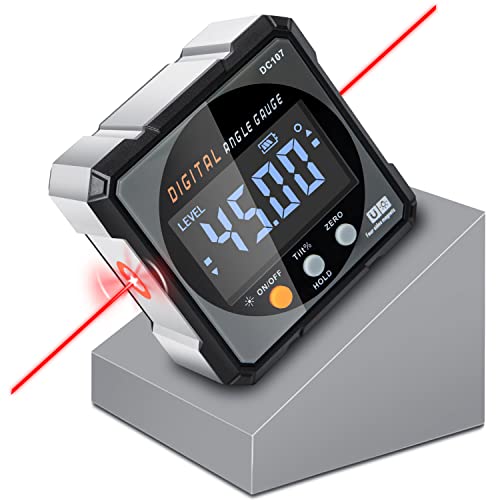
This digital cube inclinometer is built for machine setup. Strong magnets on four sides let it stick to cast iron tops, fences, and blades. Set zero on your table, tilt the blade, and dial in the exact angle. The backlight helps in low light, and the laser aids alignment on-site.
For repeat jobs, a digital readout saves time. You can confirm 90°, set 45°, or fine-tune a tricky bevel with confidence. I reach for a cube like this to get machines dead-on before any cut that matters. If you want true precision, this ranks high among the best protractors for woodworking in modern shops.
Pros:
- Digital display for quick, accurate readings
- Four-side magnets grip tables, fences, and blades
- Zero function for relative angle setup
- Backlit screen improves visibility indoors
- Laser helps with line-of-sight alignment
- Great for table saws, miter saws, and jointers
Cons:
- Battery dependency; keep a spare on hand
- Not for scribing marks directly on wood
- Must avoid metal dust in battery bay
My Recommendation
Get this if machine accuracy is your priority. It is ideal for dialing in saw blades, squaring fences, and repeating precise bevels. Pair it with an analog protractor for marking. For anyone seeking the best protractors for woodworking in a digital format, this cube delivers speed and confidence.
| Best for | Why |
| Table saw and miter saw setup | Digital readout and magnets ensure precise tilt |
| Low-light work | Backlit display and laser aid visibility |
| Repeatable bevel cuts | Zero-set lets you dial in the same angle again |
FAQs Of best protractors for woodworking
Do I need both a digital angle finder and a manual protractor?
Yes, if you want speed and accuracy. Use the digital for machine setup, and the manual for marking and transferring lines. Many pros keep both.
What angle range do I need for woodworking?
Most work uses 0° to 180°. A two-arm or square-head style covers miters, bevels, and inside/outside checks. Digital cubes complement this for machine tilt.
How accurate should my protractor be?
For layout, readable markings and a firm lock matter most. For machines, a digital cube with fine resolution helps. Aim for repeatability first.
Are stainless steel protractors better than plastic?
For shop use, yes. Stainless protractors resist wear and keep crisp markings. Plastic is fine for quick checks or templates.
How do I keep a protractor accurate over time?
Store it clean and dry. Don’t drop it. On digital units, zero on a known flat surface before use. Check against a known square often.
Final Verdict: Which Should You Buy?
The General Tools #17 is a rock-solid daily driver for layout and transfer. The digital magnetic angle finder shines for precise machine setup. Together, they cover most shop needs.
If you’re building a core kit of the best protractors for woodworking, pair one analog protractor with the digital cube. Add a compact two-arm or plastic set as a low-cost backup.