

The best miter saw blades for woodworking deliver clean, accurate, tear‑free cuts.
You buy wood to see it shine, not to sand away tear-out for hours. I have been in that spot: a fresh coat of paint waiting, but ragged edges stall the job. The right blade changes everything. With the best miter saw blades for woodworking, I make crisp crosscuts, smooth miters, and tight joinery with less fuss.
Trim looks sharp. Veneer stays intact. Hardware lines up without a fight. If you want pro-level results at home or on site, start by pairing your saw with a blade built for the task.
5 Best Miter Saw Blades for Woodworking
WEN BL1080 10-In 80T Ultra-Fine Finish Blade
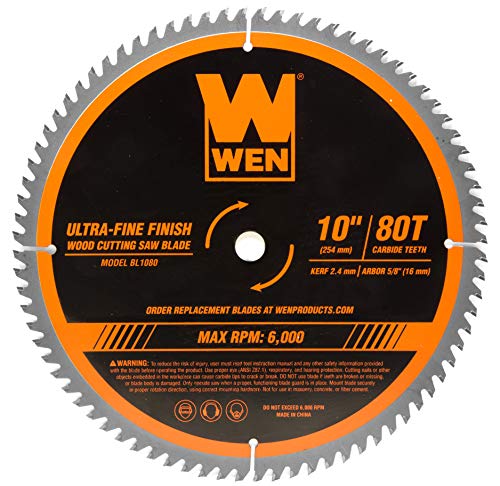
This 10-inch, 80-tooth blade is tuned for fine crosscuts. It is made for trim, casework, and precise miters. The high tooth count helps reduce tear-out on hardwoods and veneered panels. It also cuts clean on MDF and plywood, which saves time on touch-ups.
The WEN BL1080 fits most 10-inch miter saws and table saws with a 5/8-inch arbor. Carbide-tipped teeth boost edge life and allow for sharpening down the road. The plate tracks straight, which keeps cuts square and smooth. It is a strong pick if you want a refined finish at a fair price.
Pros:
- Very smooth crosscuts in hardwoods and softwoods
- Great for trim, picture frames, and crown moldings
- Reduces chip-out on plywood and MDF veneers
- Carbide tips hold an edge and can be resharpened
- Good value for an 80-tooth fine finish blade
- Stable plate helps keep cuts straight and true
- Quiet, controlled feel with minimal vibration
Cons:
- Slower feed rate on rips or thick stock
- Not ideal for non-ferrous metals or plastics
- May need a zero-clearance fence for ultra-thin veneers
My Recommendation
If you want crisp miters and paint-ready edges, this is a smart buy. I reach for an 80T when I need a clean crosscut without burn marks. It shines on baseboards, chair rail, and door casings. It also performs well on cabinet parts where edge quality matters.
Among the best miter saw blades for woodworking, the BL1080 hits that sweet spot of price and finish. It suits hobbyists upgrading from a stock blade. It also suits pros who want a dependable daily driver for trim and finish work. Keep it clean, and it will keep your projects looking sharp.
| Best for | Why |
|---|---|
| Finish carpentry and trim | 80 teeth give smooth, tear‑free crosscuts |
| Plywood and MDF | High tooth count limits chip-out on fragile veneers |
| 10-inch miter saw users | Standard 5/8-inch arbor and balanced plate for accuracy |
WEN BL1200 12-In 100T Ultra-Fine Finish Blade

This 12-inch, 100-tooth blade is built for glass-smooth cuts. It is ideal for large crown, wide baseboards, and fine finish work. On melamine and prefinished plywood, it helps prevent chipping on both faces. I use a 100T when I want a “sandpaper optional” cut edge.
The BL1200 suits sliding compound miter saws and cabinet saws that run 12-inch blades. The hefty plate helps dampen vibration across wider spans. Carbide teeth stretch out the time between sharpenings. If your projects demand the cleanest cuts, this blade brings top-tier finish to the bench.
Pros:
- Ultra-fine finish on wide moldings and panels
- Excellent choice for melamine and laminates
- Precise miters with minimal tear-out
- Carbide tips resist wear on abrasive sheet goods
- Stable, consistent performance on 12-inch saws
- Great for box making, picture frames, and tight joinery
- Helps reduce post-cut sanding and touch-ups
Cons:
- Slower feed in thick hardwood rips
- Heavier blade requires a well-tuned saw
- Overkill for rough construction cuts
My Recommendation
Pick this if you own a 12-inch miter saw and demand top finish. The 100T edge leaves trim and casework ready for stain or paint. It is one of the best miter saw blades for woodworking when working on fine furniture parts. Use a clean fence and a sharp pencil line for best results.
I suggest this for makers who cut a lot of sheet goods or wide moldings. It also helps when you must hold hairline margins on miters. If you value perfect edges, the BL1200 delivers. Availability is good, and the price is strong for the finish you get.
| Best for | Why |
|---|---|
| Melamine and laminates | 100 teeth reduce face chipping |
| Wide moldings on 12-inch saws | Stable plate and high tooth count |
| Fine furniture parts | Mirror-smooth crosscuts and tight miters |
WEN BL1280 12-In 80T Fine-Finish Saw Blade
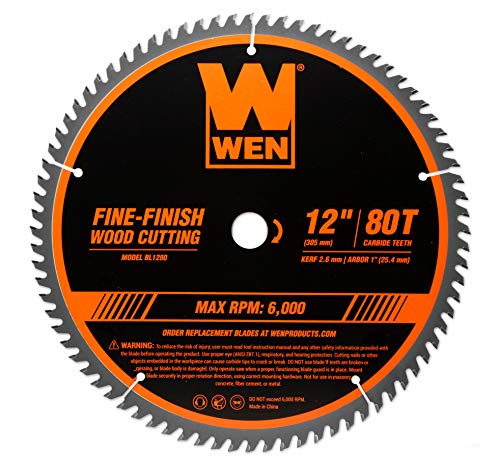
The BL1280 gives a balanced feel between speed and finish. At 80 teeth on a 12-inch plate, it makes crisp crosscuts with a touch more pace than a 100T. It is a smart pick for both solid wood and sheet goods. You get smooth edges without the slow feed of ultra-high tooth counts.
This blade fits 12-inch miter saws and table saws with a standard arbor. It handles hardwood trim, softwood casing, and cabinet parts well. Carbide teeth help it stay sharp across mixed materials. I like it for daily shop work where I need quality and speed.
Pros:
- Smooth finish with faster feed than 100T
- Works well on hardwood, softwood, and plywood
- Good choice for mixed trim and cabinet work
- Durable carbide tips for long service life
- Stable tracking for accurate miters and crosscuts
- Efficient on sliding miter saws
- Solid value for a 12-inch fine finish blade
Cons:
- Not as glass-smooth as a 100T on melamine
- Still not ideal for heavy rips in thick stock
- Large diameter demands careful saw alignment
My Recommendation
If you want a do-most 12-inch blade for fine work, pick this one. It is one of the best miter saw blades for woodworking when you balance cut quality with speed. I use an 80T on job sites where I move from trim to cabinet parts. It keeps the pace up without rough edges.
Choose it if your saw needs to handle both hardwood and panels. It is also ideal if you want to buy once for general finish work. The BL1280 is widely available and priced right for its performance. Keep it clean, and it will deliver consistent results.
| Best for | Why |
|---|---|
| Mixed trim work | 80 teeth balance finish and feed rate |
| Cabinet parts and panels | Clean crosscuts with low chip-out |
| 12-inch sliding miter saws | Stable plate supports smooth, accurate cuts |
WEN BL1040 10-In 40T Carbide Saw Blade
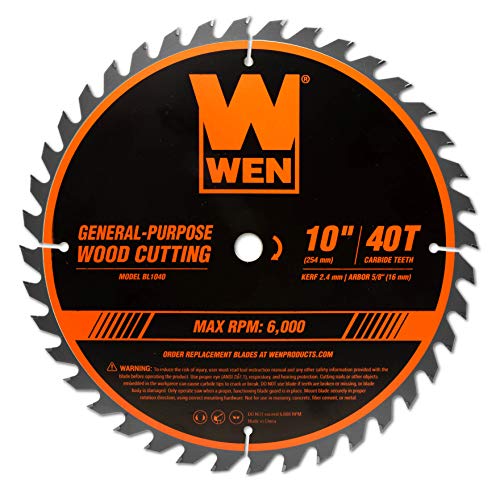
The BL1040 is a sturdy general-purpose blade. With 40 teeth on a 10-inch plate, it cuts fast and clean enough for many jobs. It is ideal for framing, deck work, and rough to semi-fine carpentry. It will also handle light crosscuts in trim when speed matters more than perfection.
This blade shines when you need throughput with decent edge quality. Carbide teeth offer strong wear resistance on softwoods and construction lumber. It also performs well on shop jigs and utility cuts. For the price, it is a hard-working option you will not fear to push.
Pros:
- Fast cutting through softwoods and construction lumber
- Durable carbide teeth for extended use
- Versatile for rough carpentry and shop tasks
- Affordable way to upgrade from a stock blade
- Stable tracking on 10-inch miter and table saws
- Good for crosscutting 2x stock and trim to length
- Handles occasional plywood cuts with care
Cons:
- More tear-out on fine veneers and melamine
- Not a first choice for high-end finish work
- May require sanding on paint-grade cuts
My Recommendation
Use this when you need speed and value. It is a smart blade for job sites, shop jigs, and general carpentry. If you also keep an 80T or 60T for fine cuts, the BL1040 rounds out your kit. It is not one of the best miter saw blades for woodworking for ultra-fine trim, but it is a strong utility blade.
It suits DIYers and contractors who cut a lot of framing lumber. It also fits makers who want a second blade for rough work. The BL1040 is often in stock and easy to replace. Keep a spare for those heavy days.
| Best for | Why |
|---|---|
| Framing and rough carpentry | 40 teeth deliver fast cuts with acceptable finish |
| 2x stock and softwoods | Carbide tips resist wear and heat |
| Budget-friendly upgrade | Stronger performance than many stock blades |
WEN BL1060 10-In 60T Fine-Finish Saw Blade
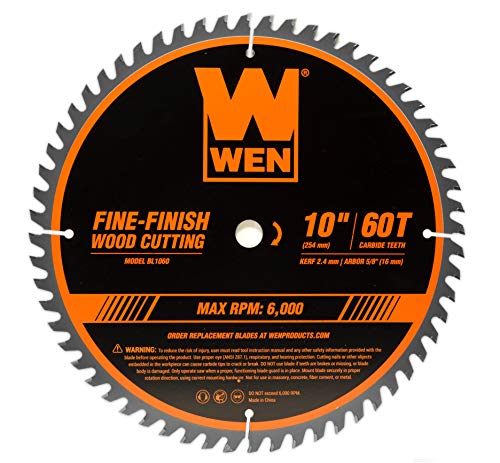
The BL1060 is the “just right” blade for many shops. At 60 teeth on a 10-inch plate, it blends clean cuts with decent speed. It is my go-to when I move from trim to plywood to hardwood in one day. It will not match an 80T on ultra-fine work, but it is close.
This blade cuts molding, furniture parts, and cabinet panels well. Carbide teeth stand up to MDF and pine without dulling fast. It fits most 10-inch miter saws and table saws with a standard arbor. If you own one 10-inch blade for fine work, this is a strong pick.
Pros:
- Clean crosscuts with a reasonable feed rate
- Versatile for trim, hardwood, and sheet goods
- Carbide-tipped teeth resist wear and chipping
- Good accuracy on miters and segment cuts
- Affordable upgrade for 10-inch saw users
- Better chip control than 40T on veneers
- Easy to keep sharp and clean
Cons:
- Not as flawless as 80T/100T on melamine
- Still slower for heavy rips
- Benefits from a zero-clearance insert for best edges
My Recommendation
If I could only keep one 10-inch finish blade, I would pick this 60T. It is one of the best miter saw blades for woodworking when you want one blade to do most tasks well. It is gentle on veneers and fast enough for daily work. Pair it with a 40T for rough and an 80T for very fine tasks to cover all bases.
This blade fits DIYers growing into finer projects. It also suits pros who need a reliable, versatile cutter. The value is strong, and it is easy to find. It is a great entry into clean woodworking cuts.
| Best for | Why |
|---|---|
| One-blade shop setups | Balanced 60T design handles most cuts cleanly |
| Trim and cabinet work | Good finish with manageable feed speed |
| Budget-conscious upgrades | Strong performance without premium pricing |
FAQs Of best miter saw blades for woodworking
What tooth count is best for clean crosscuts?
For very clean crosscuts, use 80T to 100T on 10- to 12-inch blades. A 60T also does well for most fine tasks.
Do I need a different blade for ripping?
Yes. Use 24T to 40T for ripping thick hardwoods. Fine-finish blades can rip, but feed slower and may burn.
How do I reduce tear-out on plywood and MDF?
Use a sharp 80T or 100T blade, add a zero-clearance fence, and support the exit side of the cut.
Will these blades fit my saw?
Most miter saws use a 5/8-inch arbor. These WEN blades match that standard in 10- and 12-inch sizes.
How often should I clean or sharpen a blade?
Clean pitch build-up when you see burn marks or extra effort. Sharpen carbides when cut quality drops.
Final Verdict: Which Should You Buy?
For most 10-inch saws, choose the WEN BL1060 60T for balanced speed and finish. Need ultra-clean edges? Pick the BL1080 80T. Running a 12-inch saw? Go BL1200 100T for the smoothest cuts, or BL1280 80T for speed and quality.
The best miter saw blades for woodworking match your goals and saw size. If you do rough work, add the BL1040 40T. Keep your blade clean, and your projects will shine.