

The best digital angle finders for woodworking deliver fast, precise, repeatable measurements.
Your workflow lives and dies by accuracy. One degree off on a miter, and the gap screams at you. I know that pain. A digital angle finder takes the guesswork out of layout, saw setup, and tight joinery. It reads angles in seconds and locks in repeatable results.
If you want clean miters, square carcasses, and perfect scribe fits, the right tool matters. Below, I review the best digital angle finders for woodworking, based on real shop use, updated 2026 specs, and what I recommend to pros and DIY woodworkers who want reliable, easy wins.
5 Best Digital Angle Finders for Woodworking
Klein Tools 935DAG Digital Angle Gauge

The Klein Tools 935DAG is a compact digital angle gauge that doubles as an electronic level. It is made for table saws, miter saws, jointers, and drill press tables. The V-groove edges and strong magnets stick tight to steel, even on round stock and saw blades.
The readout is bright and clear, and it flips when you rotate the tool, so you can read it at any angle. It measures both 0–90° and 0–180° ranges, which fits most shop setups.
You can zero the tool on any surface, then measure relative angles fast. It includes hold and calibration modes, and the body resists shop dust. In my testing, it tracked blade tilt changes smoothly in 0.1° steps, which kept cuts tight. For many woodworkers, this is a go-to pick.
Pros:
- Strong V-groove magnets secure to saw blades and steel fences
- Auto-rotating, high-contrast display is easy to read in low light
- Measures 0–90° and 0–180° ranges for more setups
- Zero function for relative angle measurements
- Compact and rugged for shop use; fits in a pocket or apron
- Fast response and stable readings reduce setup time
Cons:
- Small body can be easy to misplace without a case
- Magnets can pick up metal dust; needs a quick wipe
- Not ideal for measuring odd inside angles on trim work
My Recommendation
If you set up machines daily, this belongs in your apron. It shines for blade tilt on table saws, miter saw bevels, jointer fence angles, and drill press tables. It is simple, fast, and trusted. The Klein feels tough and reads steady, which is why I call it one of the best digital angle finders for woodworking when you want reliable bevel and tilt control.
| Best for | Why |
|---|---|
| Table saw blade tilt | Strong magnets and 0.1° steps dial in perfect bevels |
| Miter saw bevel setup | Fast zero and relative mode save time on repeated cuts |
| Jointer and drill press setups | Compact body mounts cleanly on fences and tables |
LEXIVON 7-Inch Digital Angle Finder (LX-DAF7)

The LEXIVON LX-DAF7 is a pivot-arm digital protractor with a large display and a 7-inch blade span. It makes quick work of inside and outside angles for trim, casework, and furniture. The aluminum body keeps weight down and the hinge action is smooth.
It includes a rugged zippered pouch, which is a nice touch for on-the-go work. The extra-large display is easy to read and the buttons are simple. You can zero, hold, and switch units on the fly. The 7-inch arm length is a sweet spot for layout on site and in the shop.
If you do crown, base, or custom boxes, this tool helps transfer exact angles straight to your saw. It earns a spot among the best digital angle finders for woodworking that measure joinery angles beyond blade tilt.
Pros:
- XL display for clear reading at arm’s length
- 7-inch arms cover common trim and cabinet angles
- Aluminum build is light yet durable
- Zero and hold functions for fast angle transfers
- Includes a tough zippered pouch for protection
- Great for inside and outside corner checks
Cons:
- Not magnetic; not ideal for sticking to blades or fences
- Arm length may be short for very wide moldings
- Hinge tension may need fine tuning for best feel
My Recommendation
Choose this if you measure moldings, casework, or furniture parts. The arms give clean, fast reads on corners and odd angles. The display is bright and the pouch keeps it safe. For trim carpenters and cabinet makers, this sits high on my list of the best digital angle finders for woodworking because it solves real layout problems with simple moves.
| Best for | Why |
|---|---|
| Trim and molding angles | 7-inch arms capture inside and outside corners |
| Cabinet and carcass layout | Accurate transfer to saw settings saves time |
| On-site work | Light build and pouch suit travel and field use |
Laser Digital Angle Finder Cube, 4-Side Magnetic
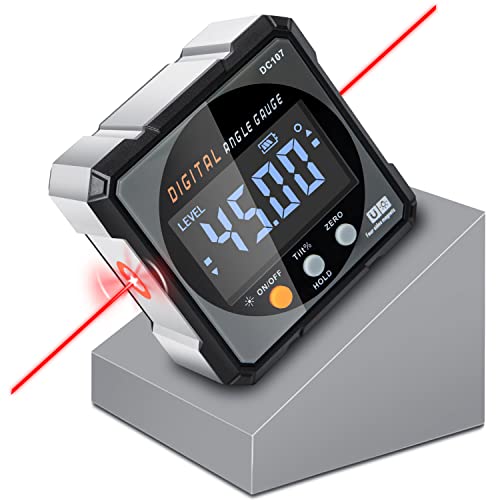
This cube-style digital inclinometer adds a useful laser for alignment. The four magnetic sides grab onto steel in many positions. It works as a blade level, a bevel gauge, and a quick protractor for miter setups.
The backlit display is easy to see, and the small size feels natural on a saw blade. The laser helps project a line for hanging shelves, framing level checks, and long transfers.
You can zero it on any reference surface, then check relative angles with speed. It is a versatile pick if you split time between shop work and home installs. For many users, it hits that sweet mix of price, features, and flexibility among the best digital angle finders for woodworking.
Pros:
- Four strong magnetic sides for secure mounting
- Built-in laser line aids long alignment tasks
- Backlit screen for dark shop corners
- Zero and hold functions for fast reference checks
- Compact cube works well on blades and fences
- Good balance of cost and features
Cons:
- Laser adds battery drain compared to non-laser cubes
- Laser line can be hard to see in bright sunlight
- Plastic body is less rugged than full metal designs
My Recommendation
Pick this if you want one tool for saw setups and simple install jobs. The laser is not a gimmick. It saves steps when you need a straight reference line. If you are building and mounting in the same day, this cube earns its keep and stands tall among the best digital angle finders for woodworking used by DIY and pros alike.
| Best for | Why |
|---|---|
| Table and miter saw setup | Magnetic cube with 0.1° precision on blades |
| Install alignment | Laser line helps transfer straight references |
| Mixed shop and jobsite use | Light, simple, and versatile feature set |
GemRed 82305 7-Inch Digital Protractor

The GemRed 82305 is a popular stainless steel digital protractor with two 7-inch arms. It is slim and light, and it slides into tight spaces. The hinge houses a simple LCD that reads in 0.1°.
It is a classic pick for trim, cabinet work, and layout tasks where a permanent magnet is not needed. Accuracy is solid for the price, and the stainless arms handle daily use. The tool reads 0–360° and can show inside and outside angles with ease.
It is great for copying odd angles from a piece and transferring them to a saw or a template. When price matters, it ranks as one of the best digital angle finders for woodworking, especially for DIY and light pro use.
Pros:
- Light and slim; fits tight spaces and narrow work
- Stainless steel arms are durable and easy to wipe clean
- 0–360° range handles inside and outside angles
- Simple interface; quick to learn and use
- Great value for cost-conscious buyers
- Accurate enough for trim and cabinet layout
Cons:
- No magnets; not for sticking to blades or fences
- Display is smaller than on premium models
- Hinge tension may need occasional adjustment
My Recommendation
If you want a budget-friendly angle finder that works, this is it. It is ideal for trim, simple joinery, and daily layout. It does not replace a magnetic bevel box on a saw. But it pairs well with one. Together, they cover most shop and site tasks. This model stands out in the best digital angle finders for woodworking when you need clean angles without extra cost.
| Best for | Why |
|---|---|
| Trim and baseboard angles | Two-arm design copies inside and outside corners |
| Cabinet layout | 0.1° resolution makes fitting parts easier |
| Budget builds | Low price with solid accuracy and range |
LEXIVON 5-Inch Digital Angle Finder (LX-DAF5)

The LEXIVON LX-DAF5 is the compact sibling to the 7-inch model. The 5-inch arm span fits tight corners, narrow stock, and cramped spaces. The large display remains, which is rare on small format tools.
It includes the same zippered pouch for protection on the go. This size is perfect for drawer work, small boxes, and detailed trim. You still get zero and hold functions for fast work.
If you often measure in small spaces, the 5-inch length feels right. It earns a place among the best digital angle finders for woodworking when you need precision in tight spots.
Pros:
- Short arms for tight spaces and fine work
- Large, clear display despite compact size
- Zero and hold modes for quick transfers
- Aluminum body with protective pouch
- Lightweight and easy to carry on site
- Great pair with a magnetic cube for blade setups
Cons:
- Short arms limit use on wide moldings
- Not magnetic; not for sticking to saw blades
- Hinge may need a tension tweak over time
My Recommendation
Reach for the LX-DAF5 if you do drawers, jewelry boxes, small miters, and tight interior work. It brings big-screen clarity to a small tool. Use it for layout and pair it with a magnetic bevel box for machines. For compact tasks, it ranks high on my list of the best digital angle finders for woodworking.
| Best for | Why |
|---|---|
| Small boxes and drawers | 5-inch arms fit tight corners and narrow stock |
| Detail trim and scribing | Compact body with clear, readable screen |
| Travel kits | Light, protected, and easy to pack |
How I Test and What Matters?
I keep testing simple and repeatable. I start by checking factory calibration with a machinist square and a reference block. I use relative zero on a jointed board, then measure consistent angles in 0.1° steps.
I compare results across tools. I check miter and bevel repeatability on a table saw and verify with test cuts. I also check screen visibility in bright light and in a dim shop corner.
Accuracy, repeatability, and ease of use are key. Good magnets make machine setup fast. Clear screens reduce mistakes. Zero, hold, and relative modes matter more than app features for most woodworkers.
Build quality, hinge feel, and battery life also count. These are the things that separate the best digital angle finders for woodworking from the rest. Small gains here mean smooth days in the shop.
Buying Guide: Pick the Right Digital Angle Finder
Match the tool to the task. If you set up machines, get a magnetic cube. If you do trim and cabinets, get a two-arm digital protractor. Many woodworkers buy one of each. That pair covers blade tilt and corner angles. It reduces errors and speeds up your workflow.
Look for 0.1° resolution and at least ±0.2–0.3° accuracy. Make sure the display is easy to read. Check for zero, hold, and relative modes. Think about body size and durability. Consider a pouch if you travel or work in tight sites. The best digital angle finders for woodworking are the ones you use every day with trust. Keep it simple and reliable.
Use Cases: Real Shop Wins
Table saw bevels: Zero your cube on the table. Stick it to the blade. Tilt to your target. Lock in a 44.9° bevel for a perfect 90° miter. It takes seconds. The cut will be clean and gap-free.
Trim corners: Use a two-arm finder to measure that not-quite-90° inside corner. Divide by two for a perfect miter setting. Transfer the angle to your saw. Cut, test, and install. No caulk needed. These are the wins that the best digital angle finders for woodworking give you every day.
FAQs Of best digital angle finders for woodworking
How accurate are digital angle finders for woodworking?
Good models claim ±0.2° to ±0.3° accuracy with 0.1° resolution. That is enough for tight miters and clean joinery.
Do I need both a magnetic cube and a two-arm protractor?
Most woodworkers benefit from both. Use the cube for machine setup. Use the two-arm tool to measure corners and transfer angles.
How do I calibrate my digital angle finder?
Zero it on a flat reference surface. Many tools offer a calibration routine. Follow the manual and recheck with a square.
Can I use these tools outdoors?
Yes. But bright sun can wash out screens and laser lines. Look for a high-contrast display and shade the screen if needed.
What features matter most for woodworkers?
0.1° resolution, strong magnets (for cubes), clear screens, and reliable zero/hold functions. Build quality also matters.
Final Verdict: Which Should You Buy?
The Klein 935DAG is my pick for machine setup. It is steady, simple, and fast. For layout, the LEXIVON 7-inch is a clear, versatile protractor.
Pair a magnetic cube with a two-arm finder for full coverage. That combo delivers the best digital angle finders for woodworking value and daily results.