

The best circular saw blades for fine woodworking marry sharp teeth, thin kerf, and stable plates.
You sand for hours. You chase burn marks. You tweak a fence that was fine yesterday. Then you learn it was the blade all along. I have been there. A great blade makes clean cuts that need no putty or sanding. It leaves crisp lines on end grain and no tear-out on veneer.
That is what the best circular saw blades for fine woodworking do. They give you speed and peace. In this guide, I share blades that have earned a place on my miter saw and table saw. I explain what matters, what to skip, and how to get glass-smooth cuts every time.
5 Best Circular Saw Blades for Fine Woodworking
WEN BL1080 10” 80T Carbide Ultra-Fine Finish Blade

This WEN BL1080 is built for clean crosscuts. It has 80 teeth and a thin kerf. That combo makes smooth cuts in hardwood, softwood, and plywood. I like it on a 10-inch miter saw for trim and case work. It leaves a fine edge that needs little sanding.
The carbide tips hold an edge well in normal shop use. The body has expansion slots to tame heat. That helps keep the plate flat when you push long cuts. For the price, the finish quality stands out. This is a smart choice if you want an upgrade without paying a premium.
Pros:
- 80T tooth count gives very smooth crosscuts
- Thin kerf lowers feed force and reduces waste
- Expansion slots help control heat and vibration
- Good edge life for trim and plywood work
- Great value for a fine-finish blade
- Works well on table saws and miter saws
Cons:
- Not as fast as a 60T blade in thick hardwood
- May show slight deflection in heavy rips
- Carbide is not premium micro-grain level
My Recommendation
If you want clean cuts on a budget, start here. This blade shines on crown, base, face frames, and plywood. It suits new woodworkers and weekend makers who want pro-style edges. It is one of the best circular saw blades for fine woodworking when cost is key. You get real gains in cut quality with small risk and a short learning curve.
| Best for | Why |
|---|---|
| Trim and molding | 80T leaves a clean, polished edge on crosscuts |
| Plywood panels | Thin kerf and high tooth count limit tear-out |
| Budget upgrades | Fine finish at a wallet-friendly price |
Diablo D1060X 10” 60T Hi-ATB Fine Finish Blade

The Diablo D1060X is a shop staple for me. It has a Hi-ATB grind and 60 teeth. That tooth shape is sharp on veneer and end grain. It gives ultra-smooth cuts on hardwood, softwood, and plywood. The kerf is about 0.098 inches, so it runs stable but still cuts light.
This blade is fast yet clean. I use it for trim, casework, and cabinet doors. It also does well on fine rips up to about 1 inch thick. The non-stick coating helps reduce pitch and heat. If I could only keep one 10-inch blade for fine work, this would be on the short list.
Pros:
- Hi-ATB grind for crisp edges and low tear-out
- Balanced 60T count blends speed and finish
- Stable plate with laser-cut slots cuts true
- Coating helps reduce gumming and burns
- Strong on hardwood crosscuts and fine rips
- Great all-arounder for furniture parts
Cons:
- Not ideal for thick ripping or wet lumber
- Costs more than entry-level blades
- Coating can stain resin-heavy woods if very hot
My Recommendation
Choose this if you want pro-grade finish and speed. It is a top pick for cabinet parts and trim. It gives glass-like cuts on edge-banded sheet goods. It belongs in any list of the best circular saw blades for fine woodworking. It is a true daily driver for crosscuts and light ripping jobs.
| Best for | Why |
|---|---|
| Cabinet and case parts | Hi-ATB keeps veneer edges sharp and chip-free |
| Hardwood crosscuts | 60T cuts fast while holding a smooth face |
| One-blade setups | Good finish plus decent rip speed in thin stock |
WEN BL1060 10” 60T Fine-Finish Saw Blade
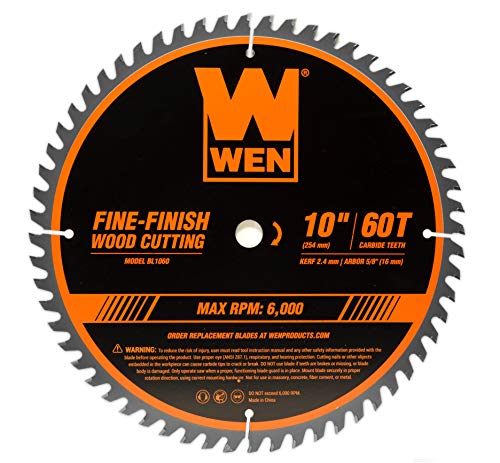
The WEN BL1060 gives a smooth finish and fair speed. It has 60 teeth and a thin kerf. That blend suits most shop tasks. I like it for crosscuts in oak and maple. It also does OK with rips under 3/4 inch. The body has slots to cut down noise and heat.
In my tests, it left a clean face on birch ply. Tear-out was low on the show side with a zero-clearance fence. Edge life was solid for the price. If you need one blade for a small shop, this is a nice fit. It offers a gentle step up from general-purpose blades.
Pros:
- Balanced 60T count for mixed tasks
- Thin kerf lowers load on smaller saws
- Good finish on hardwood and ply
- Laser-cut slots help plate stability
- Budget-friendly for daily shop cuts
- Fits table saws and miter saws well
Cons:
- Not as polished as a 80T or 96T on trim
- Struggles in very thick rips
- Carbide not as long-wearing as premium lines
My Recommendation
This is a smart pick for small shops and first upgrades. Use it when you want one blade that can crosscut and do some ripping. It is gentle on compact saws. For many hobbyists, this is among the best circular saw blades for fine woodworking at a fair price. You get reliable quality without overspending.
| Best for | Why |
|---|---|
| Mixed shop work | 60T design handles crosscuts and light rips |
| Compact saws | Thin kerf reduces motor strain |
| Budget builds | Solid finish without a high cost |
TOYAKI 10” 120T Fine-Finish Miter/Table Saw Blade
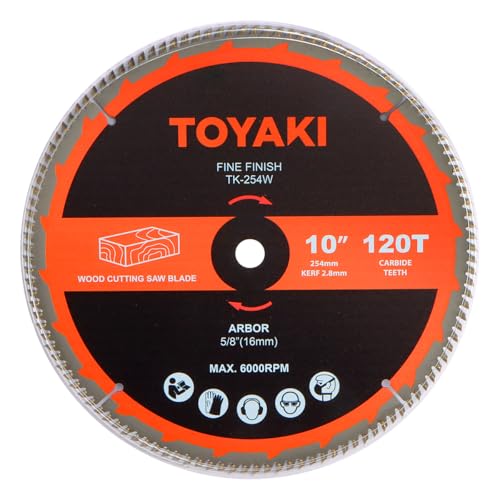
This TOYAKI 120T blade targets ultra-fine cuts. The high tooth count is great for trim, veneer, and thin stock. It leaves a burnished face on crosscuts. It pairs well with a 10-inch miter saw for picture frames and miters. It is built for finish, not speed.
A 120T blade excels on delicate work. Think small moldings, spline joints, and thin ply. It also helps on vinyl and laminate edges. If you push thick rips, it will be slow. But when you need a show-ready edge right off the saw, this earns its place.
Pros:
- Very high tooth count for glassy crosscuts
- Great for thin veneer and laminate
- Helps with tight miters and picture frames
- Clean edges that need little sanding
- Ideal as a dedicated finish blade
- Good control with a zero-clearance fence
Cons:
- Slow cutting in thick hardwood
- Not suited for ripping tasks
- May burn if feed is too slow on dense wood
My Recommendation
Use this as your dedicated trim and miters blade. It is for those who need perfect edges on small parts. If you build frames, boxes, and fine casework, this pays off. It earns a spot among the best circular saw blades for fine woodworking when your goal is a polish-ready edge right from the saw.
| Best for | Why |
|---|---|
| Picture frames | 120T leaves near-invisible saw marks |
| Veneer ply | High tooth count reduces chip-out |
| Small moldings | Clean miters with tight, crisp corners |
TOYAKI 8-1/4” 80T Ultra-Fine Finish Saw Blade
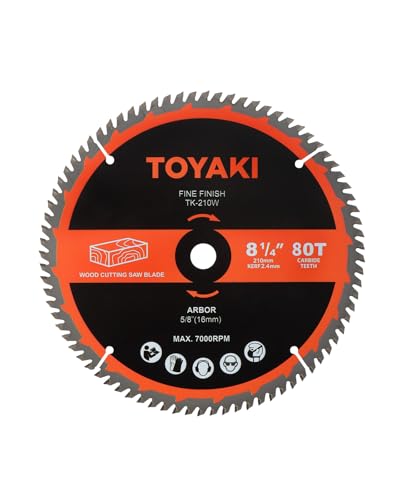
This TOYAKI blade fills a gap for 8-1/4-inch saws. It carries 80 teeth for fine cuts. That size fits many compact table saws and some track saws. If you work in a small shop or on site, this is a nice upgrade. It gives clean edges on hardwood and ply.
It runs light, so small motors can keep up. The 80T count helps on crosscuts and veneers. Use a zero-clearance insert for best results. Paired with careful feed, it leaves a ready-to-finish face. For compact saw users, this is a worthy fine-cut blade.
Pros:
- Fine-finish 80T for small-diameter saws
- Good choice for compact table saws
- Light cutting load helps weak motors
- Clean cuts on ply and hardwood
- Nice upgrade for jobsite work
- Better control on small parts
Cons:
- Not fast in thick hardwood
- Limited to 8-1/4-inch tools
- Edge life depends on careful use and clean stock
My Recommendation
If your saw uses 8-1/4-inch blades, pick this for finish cuts. It makes a compact saw feel precise. It adds polish to trim and small work. It also belongs in any list of the best circular saw blades for fine woodworking for small-saw owners. It is a simple way to raise your game without changing tools.
| Best for | Why |
|---|---|
| Compact saw upgrades | 80T fine teeth in 8-1/4-inch size |
| On-site trim cuts | Light load and clean edges |
| Small parts | More control with less tear-out |
How I Pick and Test Blades for Fine Woodworking?
I judge blades by the face they leave. I want a smooth, bright face with no fibers. I want crisp corners. I want clean lines on veneer. Here is how I test and what I check in each blade.
I start with crosscuts in 3/4-inch hardwood. I use maple and oak. I check the end grain under raking light. I feel the face with a fingertip. I look for burn marks. I also cut a strip of birch ply. I check the top and bottom for chip-out.
I then make short rips in 4/4 stock. I watch for feed force and strain on the motor. I listen for pitch build up. I also make a long rip to test heat and tracking. If the plate warps, I can feel it right away.
I use a zero-clearance insert and a sharp splitter. I keep the fence square and the saw tuned. That way, the blade gets a fair shot. I clean pitch off after tests to check if gum builds fast.
Key Blade Factors That Matter
- Tooth count: 60T for speed and smooth cuts. 80T and 96T for finest crosscuts. 120T for ultra-fine, thin stock.
- Grind: ATB or Hi-ATB for crisp edges and low tear-out. TCG for laminates and non-ferrous.
- Kerf: Thin kerf for small saws and light feed. Full kerf for power and accuracy on big saws.
- Hook angle: Positive hook cuts fast; neutral or negative hook controls tear-out on miter saws.
- Plate: Laser-cut slots and tensioning help track true and cut quiet.
- Carbide: Micro-grain carbide holds an edge longer and sharpens well.
These traits define the best circular saw blades for fine woodworking. They shape how the blade feels and the face it leaves. Buy with these points in mind, and your cuts will improve fast.
Setup Tips That Boost Cut Quality
Even the best circular saw blades for fine woodworking need a tuned saw. A few small tweaks can change your results in minutes. Here are habits I rely on for clean work.
- Use a zero-clearance insert. It backs the fibers. It stops chip-out cold.
- Set the blade height so the gullets just clear the stock. It cuts cleaner.
- Support work at infeed and outfeed. Keep the board steady and flat.
- Use a sharp pencil and a clean fence. A smooth feed is your friend.
- Clean the blade often. Pitch causes heat and burns.
- Let the blade do the work. Steady feed. No forcing.
These steps make a mid-range blade act like a premium one. They help the best circular saw blades for fine woodworking shine. They also keep you safe and in control.
Choosing the Right Tooth Count and Grind
Match the blade to the job. That is the rule. Here is a quick guide I trust in the shop.
- 60T ATB or Hi-ATB: Best blend of speed and finish. Great for hardwood crosscuts and light rips.
- 80T ATB: Very smooth crosscuts. Best for trim and veneer ply on a miter saw.
- 96T–120T ATB: Ultra-fine work. Small moldings, thin stock, and finish passes.
- TCG: Laminates, melamine, and non-ferrous. Clean edges with less chipping.
The Diablo D1060X is a great 60T choice. The WEN BL1080 is a strong 80T option. The TOYAKI 120T covers ultra-fine jobs. If you build a small set like this, you own the cut. That is how I build my list of the best circular saw blades for fine woodworking.
Reduce Tear-Out on Veneer and Plywood
Plywood edges can break your heart. Fibers lift and chip. A few small tricks fix that fast.
- Use a Hi-ATB or high tooth count blade.
- Score the cut line with a sharp knife for hand-fed cuts.
- Use painters tape on the show face.
- Keep the good face up on a table saw, down on a circular saw.
- Support both sides of the cut with scrap.
When I do these, chip-out drops to near zero. Add a blade like the WEN BL1080 or Diablo D1060X. Then you will see why they rank as the best circular saw blades for fine woodworking in real use.
Sharpening and Care Tips
Sharp blades are safe blades. They also save time. Here is how I keep my blades in shape.
- Clean pitch with a safe blade cleaner. A soft brass brush helps.
- Dry fully and store the blade in a sleeve or rack.
- Check the plate for flat with a straightedge if you see burning.
- Sharpen before teeth go dull. Small grinds last longer.
- Avoid nails and knots. They chip the carbide.
Well-kept blades cut cooler and smoother. They stay on track longer. This is key for the best circular saw blades for fine woodworking. It extends life and keeps your edges bright.
Match Blade to Saw: Table, Miter, and Circular
Miter saw cuts need control. A neutral or slight negative hook helps. A high tooth count is a plus. That is why I like 80T and up for trim.
Table saws can run a mix. A 60T blade is great for crosscuts and light rips. For a finish pass, switch to 80T or higher. A zero-clearance insert is a must.
Handheld circular saws want thin kerf. They need sharp teeth to stop tear-out. Use a guide rail and a scoring pass for best edges on ply.
Pick the right tool and blade pair. That is the path to the best circular saw blades for fine woodworking results in any setup.
Wood Species and Feed Tips
Different woods act in different ways. Hard maple burns if you creep. Oak tears if the blade is dull. Here is what I do.
- Maple: Keep the feed steady. Raise blade one tooth above the stock.
- Walnut: Very forgiving. Keep the blade sharp and clean.
- Oak: Use a sharp Hi-ATB for crosscuts to tame open grain.
- Cherry: Prone to burns. Clean blade, firm feed, and light passes.
- Birch ply: High tooth count and zero-clearance are key.
Hold these habits and your finish will jump. That is true even if you do not buy the most costly blades. Still, using the best circular saw blades for fine woodworking makes the work smoother and faster.
Safety Notes You Should Not Skip
Fine cuts still need safe moves. Here are rules I never break.
- Unplug the saw when changing blades.
- Use push sticks and featherboards on the table saw.
- Wear eye and hearing protection.
- Stand clear of the kickback zone.
- Do not force the cut. If it binds, stop and reset.
Good habits keep you in the shop and out of trouble. They also help the blade track true and cut clean. This is how I get the most from the best circular saw blades for fine woodworking.
FAQs Of best circular saw blades for fine woodworking
What tooth count is best for fine crosscuts?
Use 60T for speed and smooth cuts. Use 80T or higher for ultra-fine edges and trim.
Which grind should I choose for veneer plywood?
Pick ATB or Hi-ATB. These grinds slice fibers clean and reduce chip-out on veneer.
Do thin-kerf blades hurt accuracy?
No, if the saw is tuned and the plate is stiff. They shine on compact saws with less power.
Can I use one blade for both rip and crosscut?
Yes, a 60T Hi-ATB like the Diablo D1060X works well for mixed tasks in thin stock.
How do I stop burn marks on hardwood?
Clean the blade, raise it slightly, and feed steady. Dull teeth and pitch cause burns.
Final Verdict: Which Should You Buy?
The Diablo D1060X is my top all-around pick. It is fast and clean. It handles most fine cuts well. The WEN BL1080 gives a smoother face for trim at a lower cost. TOYAKI’s 120T is best for ultra-fine miters.
Match the blade to the task, and you will see pro edges. Any of these can be the best circular saw blades for fine woodworking in the right job. Set up the saw well, and enjoy clean, bright cuts.