

The best carpenters axes are thin-bit, well-balanced tools that cut clean and true.
When you shape joints, flatten a face, or hew a beam, a regular hatchet fights you. The bit is too thick. The edge is too obtuse. And the balance feels off. A true carpenter’s axe solves this. It gives you a thin, keen edge, stable control, and a handle that sits right in the hand.
I’ve spent years fitting handles, squaring timbers, and tuning edges in the field. Below, I break down the best carpenters axes as of 2026, so you can skip the guesswork and pick the right tool the first time.
5 Best Carpenters Axes
Husqvarna 20″ Curved Carpenter Axe

This Husqvarna 20-inch carpenter axe uses a curved hickory handle and a slim, finely ground bit. The curve adds snap on the swing while still giving stable control in close work. The head geometry is thin out front, so it slices wood fibers rather than pries them apart. That means cleaner cuts across the grain and less tear-out when you shave down to a line.
It suits cabin work, timber shaping, and careful joinery prep. I like it for planing faces on green beams and for paring tenon cheeks. The balance is neutral, which helps on long days. It also sharpens fast and holds a keen edge if you keep the apex thin. For many, this is a strong entry point into the world of the best carpenters axes.
Pros:
- Curved handle gives lively swing with good control on stops
- Thin bit slices clean, ideal for hewing and paring tasks
- Comfortable in hand; hickory absorbs shock well
- Edge is easy to touch up with a small puck or file
- Good weight for both rough shaping and fine cuts
- Affordable compared with premium Swedish boutique brands
- Finish is work-ready; needs only light edge tuning
- Works well on green or seasoned softwoods and hardwoods
Cons:
- Ships with a serviceable edge, but you may want to refine the bevel
- Curved handle is not everyone’s choice for layout cuts
- Sheath quality is basic; consider an upgrade if you carry it daily
My Recommendation
This model is best if you want one axe to do most carpentry tasks. The curved handle makes it versatile for both swing cuts and guided, two-hand control. If you are learning joinery on timbers or need a reliable field axe for scribing and shaving, this Husqvarna offers strong value. It belongs in any short list of the best carpenters axes because it blends control, comfort, and price.
| Best for | Why |
|---|---|
| All-around carpentry | Balanced weight, thin bit, forgiving handle geometry |
| Hewing and paring | Slim edge tracks a line and reduces tear-out |
| Budget-conscious buyers | Strong performance at a mid-tier price point |
Husqvarna 19″ Carpenter’s Axe

The Husqvarna 19-inch carpenter’s axe is a classic for joiners. It often features a straighter handle and a wider, flat cheek area that helps register against the work. That flat sits flush on timbers, so you can use the head as a reference when planing down to a layout line. The bit is thin, with an edge that favors push control and precision over raw chopping power.
This is one of the best carpenters axes for bench-side work and in-situ repairs. The shorter handle supports one-hand and two-hand grips. It shines when you need to clean up a scarf, reduce a high spot, or square an end-grain face. If you follow the grain and keep the bevels tuned, it leaves a very neat surface with minimal fuzz.
Pros:
- Straight handle promotes precise, two-hand guidance
- Flat cheek doubles as a reference face on timbers
- Thin bit gives fine, controlled shavings
- Compact length packs well and handles tight spots
- Edge is easy to maintain in the field
- Great for layout-driven work and careful paring
- Excellent value in the “true carpenter’s axe” space
- Comfortable weight for long sessions
Cons:
- Less chopping power than heavier, longer axes
- Arrives sharp but benefits from personal bevel tuning
- Sheath and hang may vary; inspect grain and wedge
My Recommendation
Pick this if your work is joinery-first. The straight feel and flat cheek make it a strong partner when you need repeatable, predictable cuts. It is ideal for timber framing students and for pros who want a compact tool that behaves like a hand plane when needed. Among the best carpenters axes, this one earns trust for clean results and easy control.
| Best for | Why |
|---|---|
| Timber joinery | Flat cheek registers on work; thin edge takes fine shavings |
| Tight spaces | Short length and neutral balance help in cramped areas |
| Precision shaping | Straight handle supports accurate, two-hand push cuts |
Estwing 16″ Rigger’s Axe (MRWR)
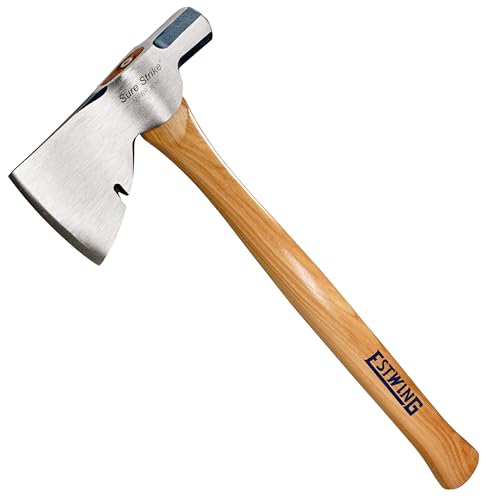
The Estwing Rigger’s Axe is a hybrid tool. Think framing hammer meets small axe. It is forged in one piece, with a smooth-face hammer poll and a compact chopping bit. The hickory handle version listed here brings a classic feel, while the head delivers the durability Estwing is known for on job sites.
For carpenters who move between nails, demo, and shaping, it saves trips to the toolbox. The bit is stout, so it excels at utility cuts and rough shaping. It is not as thin as a dedicated joinery axe, but it still handles quick notches, flush cuts, and small bevel cleanups. If you like one tool that does many tasks, this fits the bill on a build site.
Pros:
- Hammer poll and axe bit in one compact tool
- Forged head is tough and shrugs off job-site abuse
- Hickory handle gives better feel than steel-shank versions
- Good for rough carpentry and layout notching
- Balanced for one-hand use on ladders or scaffolds
- Easy to maintain; edge responds well to a file
- Reliable for framing, siding, and quick site fixes
- Great complement to a full-size framing hammer
Cons:
- Bit is thicker than a true joinery axe; not ideal for fine paring
- Short length can limit leverage in deep cuts
- Weight distribution favors utility over finesse
My Recommendation
Choose this if you work in rough carpentry and need an axe-hammer combo. It is not a purist’s hewing tool, but it shines on framing tasks and quick on-site shaping. For pros moving fast on decks, sheds, or demo, this is a practical, durable pick. It earns a spot in a broader list of the best carpenters axes because it solves a different problem: multi-role efficiency.
| Best for | Why |
|---|---|
| Job-site utility | Hammer and axe in one tool saves time and weight |
| Rough shaping | Stout bit handles quick notches and trimming |
| Durability | Forged head is tough under daily site use |
Council Tool Wood-Craft Camp Carver 16″

The Council Tool Wood-Craft Camp Carver is a 1.7 lb head on a 16-inch curved hickory handle. Though marketed for bushcraft, it is a superb small carpenter’s axe. The bit is thin for slicing and the poll is squared to aid light hammering. The factory edge is usually quite good, and the leather sheath is stout.
I use this style for bowl blanks, joinery cleanups, and green-wood carving. It excels when you want a nimble tool that still bites deep. The handle has a palm swell that locks in when you choke up. If you pride yourself on edge control, this is one of the best carpenters axes in a compact package.
Pros:
- Thin, keen bit makes clean, controlled cuts
- 16-inch handle is easy to choke up for fine work
- High-quality leather sheath included
- Head geometry favors paring and feathering
- Well-finished hickory with a secure hang
- Great bridge tool for carpentry and carving
- Light enough for long sessions without fatigue
- Poll shape is practical for light tapping
Cons:
- Small size limits heavy chopping
- Curved handle feel may not suit all joiners
- Price sits higher than basic hardware-store hatchets
My Recommendation
If you value precision over brute force, get this. It gives a carver’s control with a carpenter’s utility. I recommend it for timber framers who already own a larger hewing axe, and for woodworkers who move between shop benches and on-site installs. In any serious roundup of the best carpenters axes, this is a top compact pick for skill-first users.
| Best for | Why |
|---|---|
| Fine paring and carving | Thin edge and short handle boost precision |
| Mixed tasks | Works for joinery cleanup and bushcraft shaping |
| Travel and carry | Compact size and quality sheath for safe transport |
Estwing 14″ Sportsman’s Axe (E24A)

The Estwing Sportsman’s Axe is a 14-inch, one-piece forged hatchet with a stacked leather grip. It is built tough and shrugs off bad weather and rough use. While it is more of a camp hatchet, many carpenters keep one in the truck for quick fixes. It floats between trimming, splitting kindling, and a bit of rough shaping.
Edge geometry is thicker than a dedicated carpenter’s axe. But with a file and patience, you can thin and polish the bevel for cleaner cuts. It is at its best as a utility companion. If you want a durable backup or a tool for small site tasks, this is a safe, low-maintenance buy within the broader field of the best carpenters axes.
Pros:
- One-piece forged design is almost indestructible
- Leather grip is comfortable and looks classic
- Compact and easy to carry or stow
- Great utility tool for quick fixes and trimming
- Low upkeep; simple to clean and maintain
- Good value for a forged, USA-made tool
- Accepts edge tuning to improve slicing
- Ideal backup in a carpenter’s kit
Cons:
- Thicker bit out of the box; needs tuning for joinery
- Short handle reduces leverage for deep cuts
- Not a purpose-built carpenter’s axe
My Recommendation
Buy this as a durable utility hatchet that can pinch-hit for carpentry. It is not my first pick for fine joinery, but it saves the day often. Keep a file in the truck, thin the bevel, and it will surprise you on layout trims and notches. It deserves mention among the best carpenters axes as a rugged, do-anything sidekick.
| Best for | Why |
|---|---|
| Backup tool | Forged one-piece build handles abuse |
| Quick fixes | Compact and ready for trimming and small notches |
| Low maintenance | Simple care and reliable materials |
FAQs Of best carpenters axes
What makes a carpenter’s axe different from a hatchet?
A carpenter’s axe has a thinner bit and more control. Many have a flat cheek to register on wood. The edge is tuned for slicing, not splitting.
How sharp should a carpenter’s axe be?
Very sharp. Aim for a fine, polished edge that can shave end grain. Keep bevels even so the axe tracks your line.
What handle length is best?
For fine work, 16–20 inches is ideal. Shorter handles give control. Longer ones add power but can reduce precision.
Do I need a single-bevel (hewing) edge?
Not always. A double-bevel works for most tasks. Single-bevel shines for flat hewing and right- or left-handed work.
How do I maintain the edge?
Touch up often with a file and a stone. Remove rolls fast. Keep the bevels thin and polish to reduce tear-out.
Final Verdict: Which Should You Buy?
If you want a single tool for joinery and shaping, pick the Husqvarna 19″ Carpenter’s Axe. It registers on timbers and takes clean shavings with little effort.
For a versatile swing with more bite, the Husqvarna 20″ Curved Carpenter Axe stands out. Both are the best carpenters axes for most users today.