

The best air sanders for woodworking balance power, low vibration, and dust control.
You want smooth panels, crisp edges, and swirl-free finishes without fighting your tools. I’ve been in that spot, staring at tear-out around a knot or a wavy tabletop after hours of hard work. Air sanders solve that pain.
They’re light, cool-running, and fast. With the right pad size and orbit, you can level, blend, and polish wood with pro-grade control. In this guide, I break down the best air sanders for woodworking, what each one does best, and how to pick the right tool for your shop or jobsite.
5 Best Air Sanders for Woodworking
3-Inch Mini DA Air Sander Kit (Pads 1–3 in)

This mini dual-action air sander shines on small work. The kit includes 1, 2, and 3-inch hook-and-loop pads plus 60 sheets of mixed-grit sandpaper.
That range lets you move from tight inlays and carvings to drawer fronts and curved aprons without swapping tools. The compact body and 1/4-inch air inlet fit standard shop setups and quick-connects with ease.
I reach for 3-inch sanders when I need control and a clean finish near edges. The small orbit helps reduce burn-through on thin veneers and fragile details. It also makes blending repairs, epoxy fills, and filler touch-ups much easier. If you build guitars, boxes, or mid-century furniture with tight radii, this size is gold.
Pros:
- Three pad sizes handle tight spots, curves, and small panels
- Includes 60 sandpapers for a ready-to-work starter kit
- Lightweight body reduces fatigue during detail work
- Dual action helps prevent swirl marks on sensitive woods
- Hook-and-loop pads enable fast grit changes
- Standard 1/4-inch air inlet integrates with common hoses
Cons:
- Not ideal for large tabletops or wide panels
- Pad life depends on careful alignment and heat control
- May need extra interface pads for ultra-delicate veneers
My Recommendation
This is a great pick for luthiers, box makers, restorers, and detail-oriented woodworkers. It gives you precise control on small surfaces where big sanders feel clumsy.
If you work with hardwood edges, sculpted contours, or tricky grain, it delivers a clean, even finish with less risk. Among the best air sanders for woodworking, small DA units like this fill a vital gap between hand sanding and 5–6-inch orbit tools.
| Best for | Why |
|---|---|
| Tight corners and curves | Small pads reach detail areas without gouging edges |
| Veneers and inlays | Dual action reduces swirl and burn-through risk |
| Repairs and touch-ups | Fast grit swaps and precise control for spot work |
KUIMIT 6-Inch Dual Action Air Sander Kit

The KUIMIT 6-inch DA is a strong, value-forward kit for furniture makers and finish carpenters. The palm-sized body keeps weight down while still offering the coverage that 6-inch pads are known for.
That larger footprint speeds up leveling and final sanding on tabletops, doors, and panels. It’s a solid step up for those wanting pro-style performance without the luxury-brand price.
In my shop, a 6-inch DA is the daily driver for flattening and finish passes. It moves across big surfaces with a predictable cut and leaves a surface ready for sanding sealer or oil. The random orbit reduces visible swirls compared with straight rotary tools. If you build tables or cabinets, this format belongs in your first string.
Pros:
- 6-inch pad covers more area for faster workflow
- Dual action helps deliver a uniform, swirl-free finish
- Palm-sized body offers better control and lower fatigue
- Good value kit for shops upgrading from electric sanders
- Works well from 80–320 grits for full finish sequences
Cons:
- Requires a steady compressor; small units may cycle often
- Kit accessories vary; you may still want premium discs
- Dust capture depends on your hose and pad interface
My Recommendation
If you’re building dining tables, built-ins, or slab projects, this kit is a smart buy. It’s one of the best air sanders for woodworking when you want speed on flat work and a clean final surface. The KUIMIT 6-inch earns a spot as a cost-effective workhorse for serious DIYers and pros.
| Best for | Why |
|---|---|
| Large panels and tabletops | 6-inch pad increases coverage and levels quickly |
| Finish sanding sequences | Dual action minimizes swirls across broad grain |
| Budget-conscious pro shops | Solid performance without premium pricing |
Professional 6-Inch Air Random Orbital Sander

This low-vibration, heavy-duty 6-inch RO sander is built for long sessions. The dual action motion, combined with a balanced counterweight, helps it glide over flat stock.
You get the speed of a pneumatic with the finesse needed for film finishes. The palm form factor sits low, which improves control at the edges and reduces wrist strain.
On big glue-ups and veneered tops, this tool type gives you consistency from corner to corner. It pairs well with high-quality discs and an interface pad for final passes. With a solid compressor behind it, it can run all day without the heat that can plague corded tools. For busy shops, that is a big win.
Pros:
- Low vibration design for better comfort and control
- Heavy-duty build ready for daily, extended use
- Random orbit helps reduce pigtails and swirl marks
- Edges and corners feel safer due to low-profile body
- Plays well with premium 6-inch discs and foam pads
Cons:
- Needs a robust compressor to show its full potential
- Heavier than minimalist compact models
- Overkill for small crafts and delicate carvings
My Recommendation
Choose this if you want a dependable daily driver that can power through leveling and finish work. For many shops, this class sits at the center of the list of the best air sanders for woodworking. It is ideal for cabinet doors, dressers, and wide panels, where even cut and comfort matter most.
| Best for | Why |
|---|---|
| High-volume sanding | Low vibration reduces fatigue in long sessions |
| Veneered panels | Controlled cut helps avoid burn-through |
| Shop-standard finish passes | Balanced DA motion leaves uniform surfaces |
LEMATEC 3-Inch Flexible-Head Air Sander
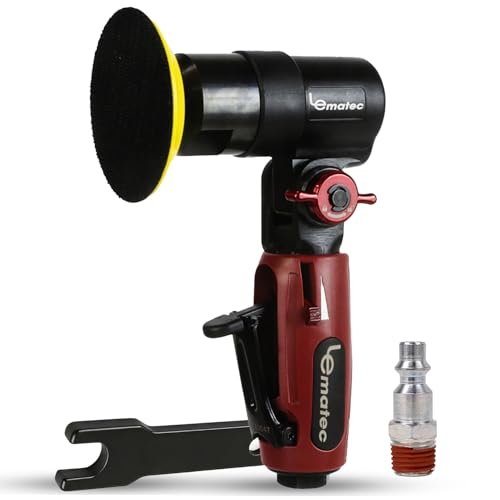
The LEMATEC features a flexible head and a 3-inch pad, with a professional-grade 5,000 RPM rating. That lower top speed gives you more control on delicate surfaces, profiles, and where heat can damage finishes.
The pivoting head helps the pad stay flat, even on irregular curves and flutes. It brings detail-level agility with a calmer, more precise feel.
I like flexible-head designs for chair spindles, crown profiles, and sculpted seats. They follow the shape instead of fighting against it. With the right foam interface, you can blend tool marks and leave the wood ready for oil, lacquer, or waterborne finishes. If you shape by hand and refine by air, this is a serious upgrade.
Pros:
- Flexible head improves pad contact on curved work
- Controlled 5,000 RPM is kind to heat-sensitive finishes
- 3-inch pad size is ideal for profiles and small parts
- Lightweight body improves reach and reduces hand strain
- Excellent for blending tool marks on sculpted pieces
Cons:
- Not the fastest for aggressive stock removal
- Fewer high-grit, 3-inch options than 5–6-inch discs
- Pivoting head adds moving parts to maintain
My Recommendation
Pick this if you build chairs, turnings, or sculpted furniture where profiles rule. It is one of the best air sanders for woodworking that demands finesse and clean curves. The flexible head keeps the pad honest on compound shapes, which helps you avoid flat spots and chatter.
| Best for | Why |
|---|---|
| Chairs and sculpted seats | Head flex and 3-inch pad track complex curves |
| Finish blending | Lower RPM reduces heat and swirl risk |
| Detail profiles | Compact size reaches flutes and small radii |
Chicago Pneumatic CP7200 3-Inch Rotary Sander

The CP7200 is a 3-inch random rotary tool from a trusted pro brand. It runs up to 15,000 RPM and is built for tight spaces and serious material removal.
The pistol-grip handle gives you leverage and control for spot leveling, rust removal, and polishing in corners. For wood, it shines at small-area flattening, hardware mortise cleanups, and blending repairs.
Chicago Pneumatic tools have a strong service network and proven internals. That matters when you run air tools hard and expect years of life. While rotary action can be more aggressive than a DA, good technique and smart grit choices keep it safe on hardwoods. Add an interface pad for final passes and it can produce a clean, even surface.
Pros:
- Durable, pro-grade construction with a 15,000 RPM ceiling
- Pistol grip offers leverage for controlled spot work
- Excellent for leveling patches, fills, and small flat zones
- Compact head reaches corners and edges with ease
- Strong support and parts availability from a known brand
Cons:
- Rotary action can be aggressive on softwoods
- Grip style is bulkier in cramped spaces
- Higher price than many budget 3-inch sanders
My Recommendation
Consider this if you need a tough, long-term 3-inch tool for targeted work. It earns a place among the best air sanders for woodworking when you favor reliability and controlled power. The CP7200 bridges the gap between auto-body and fine woodworking with a compact, capable footprint.
| Best for | Why |
|---|---|
| Spot leveling and repairs | High RPM and control for small, flat areas |
| Edge and corner access | Compact 3-inch pad and slim head reach tight spaces |
| Pro shops needing longevity | Brand support and durable internals |
How to Choose the Best Air Sander for Woodworking in 2026?
Wood moves, grain changes, and every project asks for a slightly different touch. That’s why the best air sanders for woodworking are not one-size-fits-all.
Your choice depends on pad size, orbit style, air supply, dust control, and the finish you want. Here’s how I help clients and readers match tools to tasks with fewer surprises.
Random Orbit vs. Rotary vs. Dual Action
Random orbit (RO) sanders move in circles plus an offset orbit to avoid swirl. They are the safest bet for most fine woodworking. Rotary sanders spin on one axis. They remove material fast but can leave marks if you stay in one spot.
Dual action sanders blend the two. They cut and finish well without obvious patterns. For most wood shops, a RO or DA is the daily driver, with a rotary tool on hand for spot jobs.
Pad Size: 3-Inch vs. 5-Inch vs. 6-Inch
Pad size dictates coverage and control. Three-inch pads excel in curves, corners, repairs, and small boxes. Five-inch pads are nimble all-rounders for furniture parts.
Six-inch pads level wide panels faster and leave clean surfaces with fewer passes. If you only pick one for furniture making, a 6-inch DA is often the best air sander for woodworking on big panels. Add a 3-inch for detail work and you can handle most tasks.
Orbit Diameter and Finish Quality
Tools vary in orbit size (the off-center movement). A smaller orbit leaves a finer finish but cuts slower. A larger orbit removes stock faster but can show more pattern if you rush. When finish matters, use a small orbit with a foam interface pad and finer grits. Always vacuum or blow off dust between grits. Dust left on the wood turns into scratches at the next pass.
Air Supply: CFM, PSI, and Compressor Sizing
Pneumatic sanders need steady air. Most 5–6-inch tools want moderate to high CFM at around 90 PSI. Small garage compressors can run 3-inch tools in bursts. For steady use with 6-inch sanders, upgrade your tank size and CFM rating.
Long hoses drop pressure. Use 3/8-inch or larger hoses and full-flow fittings for best results. If your tool starves, it will slow and lose cut. That invites pressing harder, which causes swirls and heat.
Dust Extraction and Clean Air
Wood dust is a health risk. A sander that works with your vac is a smarter buy. Many pads support multi-hole patterns. Match discs to pads and use a vac hose or central system.
An interface pad can help air pull dust through the disc. Good dust control keeps your work cleaner and reduces clogging. Your finish looks better, and you breathe easier.
Vibration, Weight, and Ergonomics
Low vibration matters. It reduces numb hands and lets you feel the surface. Palm sanders with balanced internals and soft grips help. Weight is a trade-off. Heavier sanders can dampen chatter.
Lighter tools reduce fatigue on vertical work. Try to hold the tool near the surface to keep control. Let the sander’s weight and motion do the work. Don’t push hard.
Speed Control and Regulators
Many air sanders use an inline regulator or throttle to control speed. This is key for exotic woods and veneers. Lower speed reduces heat. It also helps when stepping to higher grits like 320–600.
If your tool does not include a regulator, add one at the handle or hose. Fine control turns a good tool into one of the best air sanders for woodworking tasks that demand care.
Hoses, Fittings, and Interfaces
Set up your hose and fittings right. Use high-flow couplers sized to your hose. Keep hose runs short and avoid sharp bends. For finish sanding, add an interface pad between the hook-and-loop pad and your disc.
It cushions the cut, especially on veneer and profiles. Keep extra pads on hand. Worn hooks reduce disc grip and can cause chatter.
Grit Progression That Works
Do not skip too many steps. A common plan is 80 or 100, then 120, 150, 180, and 220. For film finishes, end at 220–320. For oil finishes, stopping at 180–220 can improve penetration.
Wipe or vacuum between grits. Change discs often; dull paper heats and scratches. A patient progression is the mark of the best air sanders for woodworking results. Your work will show it.
Safety and Good Habits
Wear hearing and eye protection. Use a dust mask or respirator with fine dust filters. Keep your fingers clear of the pad edge. Lift the tool off the wood before starting or stopping to avoid divots. Follow safe air tool practices. Reputable guidelines stress proper PPE, secure workpieces, and clean, dry air supply for tool longevity.
Maintenance: Keep It Smooth
Drain water from your compressor tank daily. Use an inline filter and oil mist or regular drops if your tool requires it. Check pads for wear and replace as needed. Inspect hoses and fittings for leaks. With a few minutes of care, even budget tools can run like the best air sanders for woodworking for years.
My Test Principles
I judge air sanders on five points: finish quality, vibration, speed of cut, dust control, and ergonomics. I run each with a consistent compressor setup and known discs across typical grit steps.
I sand hardwood panels, veneered stock, and curved scraps to see where the tool shines or stumbles. That repeatable approach shows small differences that matter in real builds.
FAQs Of best air sanders for woodworking
What pad size should I buy first?
Start with a 6-inch DA for panels and tabletops. Add a 3-inch sander for curves and detail work.
Can a small compressor run a 6-inch air sander?
It can run in short bursts. For steady use, you need higher CFM and a larger tank to avoid cycling.
How do I prevent swirl marks on hardwood?
Use a dual action or random orbit tool, follow a steady grit progression, and lighten pressure at higher grits.
Do I need dust extraction with air sanders?
Yes. Good dust control improves health and finish quality. Use matched pads, discs, and a vac.
Are rotary air sanders safe on veneers?
They can be, but go slow. Use fine grits, an interface pad, and light pressure to avoid burn-through.
Final Verdict: Which Should You Buy?
For broad woodworking tasks, a 6-inch DA like the KUIMIT or the Professional 6-Inch RO is the safest, fastest pick. They deliver clean finishes on panels and doors and earn a top spot among the best air sanders for woodworking.
For profiles and repairs, pair your main sander with a 3-inch tool: the Mini DA kit for finesse, the LEMATEC for curved control, or the CP7200 for power. Together, they cover almost every shop need.